
Best Cities for Tech Jobs in Africa 2026
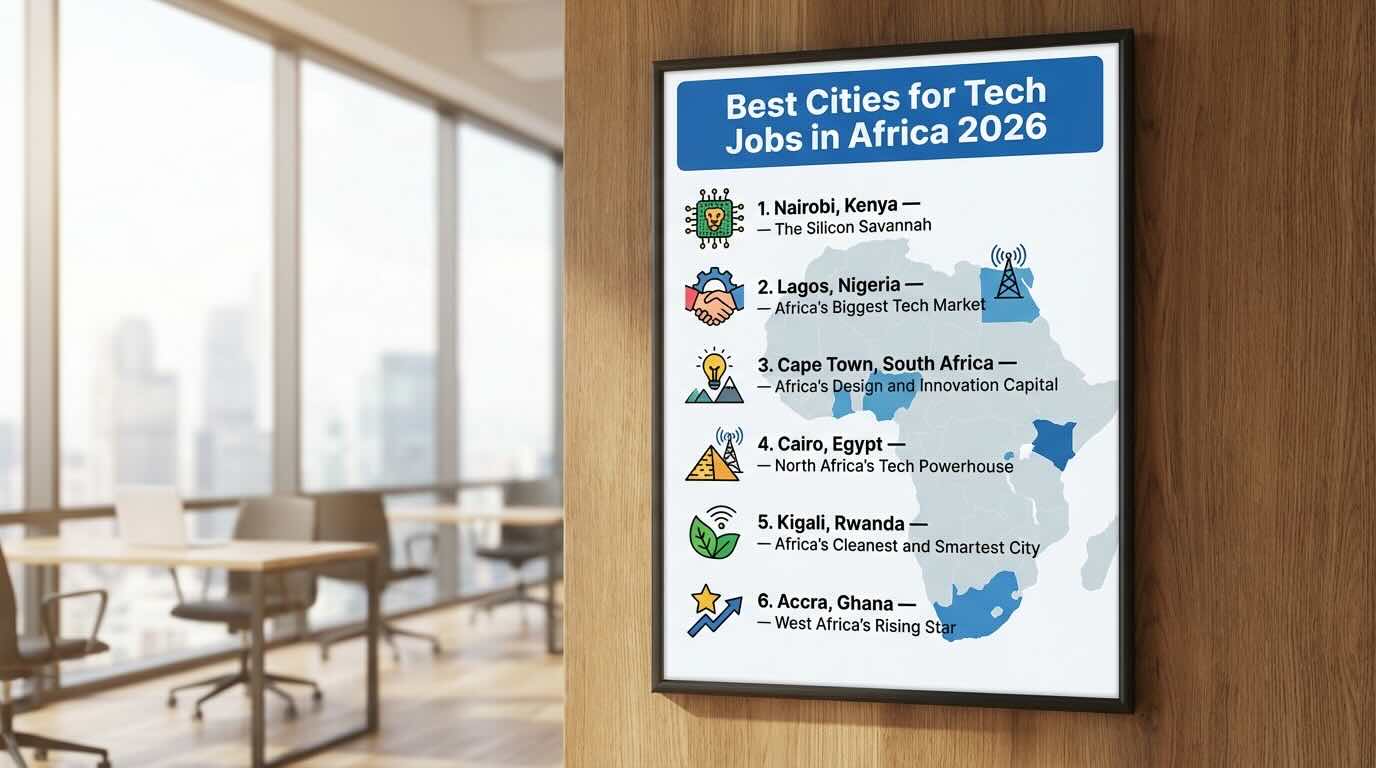
Best Cities for Tech Jobs in Africa 2026: Where to Build Your Career
Africa's technology sector is booming. The continent is home to over 5,000 active tech startups, received more than USD 6 billion in venture capital funding in 2025, and employs millions of technology professionals across diverse roles. But not all cities are created equal when it comes to tech opportunities, career growth, salaries, and quality of life.
Whether you are a software developer looking for your next role, a startup founder choosing where to base your company, or a tech professional considering a move within the continent, this guide provides a comprehensive comparison of Africa's top six cities for tech jobs in 2026. We evaluate each city on its startup ecosystem, average tech salaries, quality of life, infrastructure, and growth trajectory.
Ready to explore tech opportunities across Africa? Browse the latest listings on the Masters Africa job board.
1. Nairobi, Kenya — The Silicon Savannah
Nairobi has earned its reputation as Africa's innovation capital. Home to the famous "Silicon Savannah," the city's tech ecosystem has matured significantly over the past decade, evolving from a promising startup scene into a fully developed technology hub with world-class talent, institutional support, and a thriving venture capital landscape.
Startup Ecosystem
Nairobi hosts over 600 active tech startups, making it one of Africa's densest startup ecosystems. The city is particularly strong in fintech, with M-Pesa having pioneered mobile money and inspired a generation of financial technology companies. Major tech hubs and incubators include iHub, Nairobi Garage, Nailab, and the recently expanded Konza Technopolis. International tech companies including Google, Microsoft, Visa, and Mastercard have established their African headquarters or significant regional offices in Nairobi.
Average Tech Salaries
- Junior Developer: KSh 80,000 - 150,000/month (USD 550 - 1,030)
- Mid-Level Developer: KSh 200,000 - 400,000/month (USD 1,380 - 2,760)
- Senior Developer: KSh 400,000 - 800,000/month (USD 2,760 - 5,520)
- Engineering Manager: KSh 600,000 - 1,200,000/month (USD 4,140 - 8,280)
- Data Scientist: KSh 250,000 - 600,000/month (USD 1,725 - 4,140)
- UX/UI Designer: KSh 150,000 - 400,000/month (USD 1,035 - 2,760)
Quality of Life
Nairobi offers a pleasant climate year-round with temperatures averaging 17 to 25 degrees Celsius. The city has a vibrant social scene, excellent restaurants, and easy access to wildlife parks and natural attractions. Cost of living is moderate compared to global tech hubs, with a comfortable lifestyle achievable on a mid-level tech salary. The city's traffic congestion remains a challenge, but remote work and flexible hours have mitigated this for many tech professionals.
Infrastructure
Internet connectivity has improved significantly, with fiber-to-the-home available in most neighborhoods through providers like Safaricom, Zuku, and Faiba. Average broadband speeds range from 25 to 100 Mbps. Power reliability has improved but UPS backup is still recommended. The city boasts numerous co-working spaces and tech-focused facilities.
Explore developer opportunities in Nairobi on Masters Africa's Nairobi developer page.
2. Lagos, Nigeria — Africa's Biggest Tech Market
Lagos is Africa's largest city and its most dynamic business environment. With a metropolitan population exceeding 20 million, Lagos offers the sheer scale of market opportunity that no other African city can match. The tech ecosystem here is characterized by ambition, resilience, and rapid growth.
Startup Ecosystem
Lagos dominates African tech funding, consistently attracting the largest share of venture capital on the continent. The city is home to multiple unicorns and near-unicorns including Flutterwave, Paystack (acquired by Stripe), Andela, and Interswitch. The Yaba neighborhood, nicknamed "Yabacon Valley," serves as the epicenter of the startup scene, though tech companies are increasingly spread across Victoria Island, Lekki, and Ikoyi. Key support institutions include Co-Creation Hub (CcHUB), Lagos Innovates, and numerous venture capital firms.
Average Tech Salaries
- Junior Developer: NGN 250,000 - 500,000/month (USD 160 - 325)
- Mid-Level Developer: NGN 600,000 - 1,200,000/month (USD 390 - 775)
- Senior Developer: NGN 1,200,000 - 3,000,000/month (USD 775 - 1,935)
- Engineering Manager: NGN 2,000,000 - 5,000,000/month (USD 1,290 - 3,225)
- Data Scientist: NGN 700,000 - 1,800,000/month (USD 450 - 1,160)
- Product Manager: NGN 800,000 - 2,500,000/month (USD 515 - 1,615)
Note that many Lagos-based tech professionals working for international companies remotely earn significantly more than these locally-benchmarked figures.
Quality of Life
Lagos is a city of contrasts. It offers incredible energy, cultural richness, world-class dining, and an unmatched nightlife scene. However, challenges include heavy traffic congestion, flooding during rainy season, and the general intensity of navigating a megacity. The Lekki and Victoria Island areas offer more comfortable living for tech professionals, though at a premium cost. Lagos rewards those who embrace its dynamism and learn to navigate its complexities.
Infrastructure
Internet infrastructure in Lagos has improved considerably, with fiber-to-the-home expanding through providers like MainOne, Spectranet, and Smile. Average speeds of 15 to 50 Mbps are typical in well-served areas. Power supply remains a significant challenge, and most tech professionals and companies rely on generators, inverters, or solar backup systems. Co-working spaces with reliable power and internet are a popular solution.
Find tech opportunities in Lagos on Masters Africa's Lagos jobs page.
3. Cape Town, South Africa — Africa's Design and Innovation Capital
Cape Town consistently ranks as one of the world's most livable cities, and its tech sector has grown to match its reputation for quality of life. The city has established itself as Africa's premier destination for design-forward tech companies, international remote workers, and digital nomads.
Startup Ecosystem
Cape Town's tech ecosystem is characterized by maturity and diversity. The city hosts major companies like Naspers/Prosus (Africa's largest tech company), Takealot (South Africa's largest e-commerce platform), and Yoco (a leading fintech startup). The venture capital landscape is well-developed, with firms like Knife Capital, 4Di Capital, and Kalon Venture Partners actively investing in local startups. The city is particularly strong in e-commerce, fintech, edtech, and enterprise software.
Average Tech Salaries
- Junior Developer: ZAR 20,000 - 35,000/month (USD 1,050 - 1,840)
- Mid-Level Developer: ZAR 40,000 - 70,000/month (USD 2,105 - 3,685)
- Senior Developer: ZAR 75,000 - 130,000/month (USD 3,950 - 6,840)
- Engineering Manager: ZAR 100,000 - 180,000/month (USD 5,265 - 9,475)
- Data Scientist: ZAR 50,000 - 100,000/month (USD 2,630 - 5,265)
- UX/UI Designer: ZAR 35,000 - 75,000/month (USD 1,840 - 3,950)
Quality of Life
Cape Town offers arguably the best quality of life of any city on this list. The natural beauty is stunning, with Table Mountain, pristine beaches, and world-class wine regions within easy reach. The city has a Mediterranean climate with warm, dry summers and mild winters. Excellent restaurants, cultural attractions, and outdoor activities abound. The cost of living is moderate by international standards, though higher than most other African tech hubs.
Infrastructure
Cape Town boasts Africa's best internet infrastructure, with widespread fiber availability offering speeds of 50 to 1,000 Mbps. Power supply has stabilized following years of load shedding challenges, with increased renewable energy adoption providing more reliability. The city has numerous world-class co-working spaces, particularly in the Woodstock, CBD, and Century City areas.
Explore tech jobs in Cape Town on Masters Africa's Cape Town page.
4. Cairo, Egypt — North Africa's Tech Powerhouse
Cairo has emerged as a formidable tech hub, leveraging Egypt's large, young population and its strategic position between Africa, the Middle East, and Europe. The city's tech sector has experienced explosive growth, with significant investments from both regional and international venture capital firms.
Startup Ecosystem
Cairo's startup scene has produced several notable success stories, including Swvl (transport), Fawry (digital payments), MNT-Halan (lending and fintech), and Instabug (mobile app development tools). The Greek Campus in downtown Cairo and Smart Village in 6th of October City serve as major tech hubs. Government support has increased through initiatives like the Egypt Vision 2030 digital transformation strategy and the Knowledge City project.
Average Tech Salaries
- Junior Developer: EGP 15,000 - 25,000/month (USD 300 - 500)
- Mid-Level Developer: EGP 30,000 - 55,000/month (USD 600 - 1,100)
- Senior Developer: EGP 55,000 - 100,000/month (USD 1,100 - 2,000)
- Engineering Manager: EGP 80,000 - 150,000/month (USD 1,600 - 3,000)
- Data Scientist: EGP 35,000 - 80,000/month (USD 700 - 1,600)
- Product Manager: EGP 40,000 - 90,000/month (USD 800 - 1,800)
While nominal salaries in Cairo are lower than in Nairobi or Cape Town, the cost of living is also significantly lower, resulting in competitive purchasing power for tech professionals.
Quality of Life
Cairo is a city of historical grandeur and modern complexity. The Pyramids, the Nile, and millennia of cultural heritage provide a unique backdrop for daily life. The food scene is exceptional and remarkably affordable. Challenges include traffic congestion, air quality in certain areas, and the general intensity of a megacity with over 20 million residents. New Cairo and 6th of October City offer more spacious, modern living environments popular with tech professionals.
Infrastructure
Internet infrastructure has improved significantly, with WE, Vodafone Egypt, and Orange Egypt providing fiber connections with speeds averaging 30 to 100 Mbps in well-served areas. The New Administrative Capital and Smart Village offer purpose-built tech infrastructure. Power supply is generally reliable in Cairo's major districts.
Discover opportunities in Cairo through Masters Africa's Cairo job listings.
5. Kigali, Rwanda — Africa's Cleanest and Smartest City
Kigali has defied expectations to become one of Africa's most exciting tech hubs. Rwanda's deliberate strategy to position itself as a technology-driven economy, combined with exceptional governance and infrastructure investment, has made Kigali a magnet for tech professionals and startups.
Startup Ecosystem
While smaller than Nairobi or Lagos, Kigali's tech ecosystem punches well above its weight. The Kigali Innovation City project, backed by the government and African Development Bank, aims to create a continental tech hub. k-lab, Impact Hub Kigali, and the Carnegie Mellon University Africa campus form the backbone of the innovation ecosystem. Rwanda's tech-friendly policies, including drone delivery (Zipline), cashless economy initiatives, and digital governance, create a unique testing ground for emerging technologies.
Average Tech Salaries
- Junior Developer: RWF 400,000 - 800,000/month (USD 300 - 600)
- Mid-Level Developer: RWF 900,000 - 1,800,000/month (USD 675 - 1,350)
- Senior Developer: RWF 1,800,000 - 3,500,000/month (USD 1,350 - 2,625)
- Data Scientist: RWF 800,000 - 2,000,000/month (USD 600 - 1,500)
- UX/UI Designer: RWF 600,000 - 1,500,000/month (USD 450 - 1,125)
Quality of Life
Kigali is consistently ranked as Africa's cleanest and safest city. The city's famous cleanliness, low crime rate, efficient public services, and beautiful hilly landscape create an exceptionally pleasant living environment. The climate is mild year-round due to the city's altitude. The cost of living is moderate, though imported goods can be expensive given Rwanda's landlocked geography. The food scene has improved dramatically, with a growing number of international restaurants complementing excellent local cuisine.
Infrastructure
Rwanda has invested heavily in internet infrastructure through its National Broadband Strategy. 4G LTE coverage is widespread, and fiber-to-the-home is expanding in Kigali. Average internet speeds of 15 to 40 Mbps are typical. Power supply is reliable by African standards, though not without occasional interruptions. The government's commitment to digital transformation ensures continued infrastructure improvement.
Find tech roles in Kigali on Masters Africa's Kigali listings.
6. Accra, Ghana — West Africa's Rising Star
Accra has quietly built one of Africa's most promising tech ecosystems. Ghana's political stability, strong English-speaking education system, and welcoming business environment have attracted increasing attention from international tech companies and investors.
Startup Ecosystem
Accra's tech scene has gained significant momentum with the arrival of Twitter (now X) Africa headquarters and Google's Africa AI center. The city hosts growing hubs including Impact Hub Accra, iSpace, MEST (Meltwater Entrepreneurial School of Technology), and Ghana Tech Lab. Fintech, healthtech, and agritech are particularly strong verticals. Notable Ghanaian startups include mPharma, Zeepay, and Complete Farmer.
Average Tech Salaries
- Junior Developer: GHS 3,000 - 5,500/month (USD 230 - 425)
- Mid-Level Developer: GHS 6,000 - 12,000/month (USD 460 - 920)
- Senior Developer: GHS 12,000 - 25,000/month (USD 920 - 1,920)
- Engineering Manager: GHS 18,000 - 35,000/month (USD 1,385 - 2,690)
- Data Scientist: GHS 7,000 - 16,000/month (USD 540 - 1,230)
- Product Manager: GHS 8,000 - 20,000/month (USD 615 - 1,540)
Quality of Life
Accra is known for its friendly, welcoming culture and vibrant social scene. The city offers beautiful beaches, excellent local cuisine, and a lively arts and music scene. The cost of living is relatively affordable, though neighborhoods like East Legon, Airport Residential, and Cantonments command premium rents. The climate is tropical, with temperatures averaging 25 to 32 degrees Celsius year-round.
Infrastructure
Internet infrastructure in Accra has improved steadily, with fiber connections from Vodafone, MTN, and Surfline offering speeds of 20 to 50 Mbps. Power supply has improved but remains an area of concern, with occasional outages requiring backup solutions. The growing number of co-working spaces with reliable infrastructure provides an excellent alternative for remote workers and small teams.
Explore tech opportunities in Accra on Masters Africa's Accra page.
Comparing the Cities: At a Glance
Best for Highest Tech Salaries
Cape Town leads in absolute salary figures, followed by Nairobi. However, when adjusted for cost of living, Nairobi and Kigali offer excellent purchasing power for tech professionals.
Best for Startup Opportunities
Lagos offers the largest market opportunity and most active venture capital scene. Nairobi follows closely with a more mature ecosystem and better infrastructure.
Best for Quality of Life
Cape Town is the clear winner for lifestyle, followed by Kigali for those who prefer a smaller, cleaner city environment.
Best for Career Growth
Nairobi and Lagos offer the most diverse career paths and the highest concentration of international companies with African offices.
Best for Remote Work Base
Cape Town leads with the best internet infrastructure and co-working scene. Kigali is an emerging favorite for its combination of reliability, safety, and affordability.
Making Your Decision
Choosing where to build your tech career in Africa depends on your personal priorities, career stage, and lifestyle preferences. Here are some questions to guide your decision.
- Are you early in your career? Lagos and Nairobi offer the most job opportunities and the steepest learning curves.
- Do you prioritize quality of life? Cape Town and Kigali are hard to beat for lifestyle.
- Are you a founder? Lagos offers the biggest market, while Nairobi provides the best balance of talent, infrastructure, and investor access.
- Do you want international exposure? Nairobi and Cape Town host the most international tech companies.
- Is affordability key? Cairo, Accra, and Kigali offer the best value for money.
Conclusion
Africa's tech landscape in 2026 is more vibrant and diverse than ever. Each of these six cities offers unique advantages for tech professionals, and the best choice ultimately depends on your individual circumstances and goals. The good news is that whichever city you choose, you will be joining a dynamic, growing ecosystem with enormous potential.
Ready to take the next step? Browse tech jobs across Africa on Masters Africa and find opportunities in all of these cities and beyond. If you are an employer looking to build a team in any of these tech hubs, explore our hiring plans to get started.
For salary benchmarks in specific cities and roles, visit our Salary Insights page, updated regularly with the latest market data from across the continent.